About the Sanford Stem Cell Institute
The Sanford Stem Cell Institute (SSCI) is a global leader in regenerative medicine and a hub for stem cell science and innovation in space. SSCI aims to catalyze critical basic research discoveries, translational advances and clinical progress, terrestrially and in microgravity. Its goal is to develop and deliver novel therapeutics to patients who need them most — those with draconian, life-altering and life-threatening conditions like cancer, epilepsy, Parkinson’s disease, type 1 diabetes, chronic heart failure, Alzheimer’s disease, ALS, spinal cord injury and myriad others.
SSCI leverages state-of-the art core research facilities for stem cell translational medicine and an extensive Alpha Stem Cell Clinic Network across California to conduct clinical trials of promising new regenerative medicines.
Our History
SSCI builds upon a $100 million gift in 2013 from philanthropist T. Denny Sanford that established UC San Diego as a leader in developing and delivering the therapeutic promise of human stem cells — special cells in the human body with the ability to develop into many different cell types. When modified and repurposed, stem cells have the potential to treat a vast array of conditions and diseases.
In 2022, Sanford committed another $150 million to the creation of SSCI. This gift combined existing infrastructure with six new centers launched to leverage the advantages of space-based science, further advances in regenerative medicine and train the next generation of stem-cell researchers.
Our Centers
Those centers include:
- The Sanford Integrated Space Stem Cell Orbital Research (ISSCOR) Center, a cutting-edge laboratory designed to perform experiments aboard the International Space Station. Astronauts perform experiments at the direction of, and in tandem with, scientists on the ground. Space-based experiments harness the power of sustained microgravity, which exists only in low-Earth orbit. This lack of gravity mimics the aging process on Earth but in an accelerated fashion.
- The Sanford Stem Cell Innovation Center, which is dedicated to expediting the translation of scientific insights into clinical therapies by propelling the frontiers of genomic technologies, harnessing the potential of human induced pluripotent stem cell models and synergizing artificial intelligence with novel genomic modalities.
- The Sanford Stem Cell Discovery Center, which conducts basic and translational stem cell research and trains the next generation of regenerative medicine scientists.
- The Sanford Advanced Therapy Center, which provides leading-edge services for the development, testing and good manufacturing practices (GMP) production of innovative therapy products for investigational new drug (IND)-enabling and early-phase clinical trials.
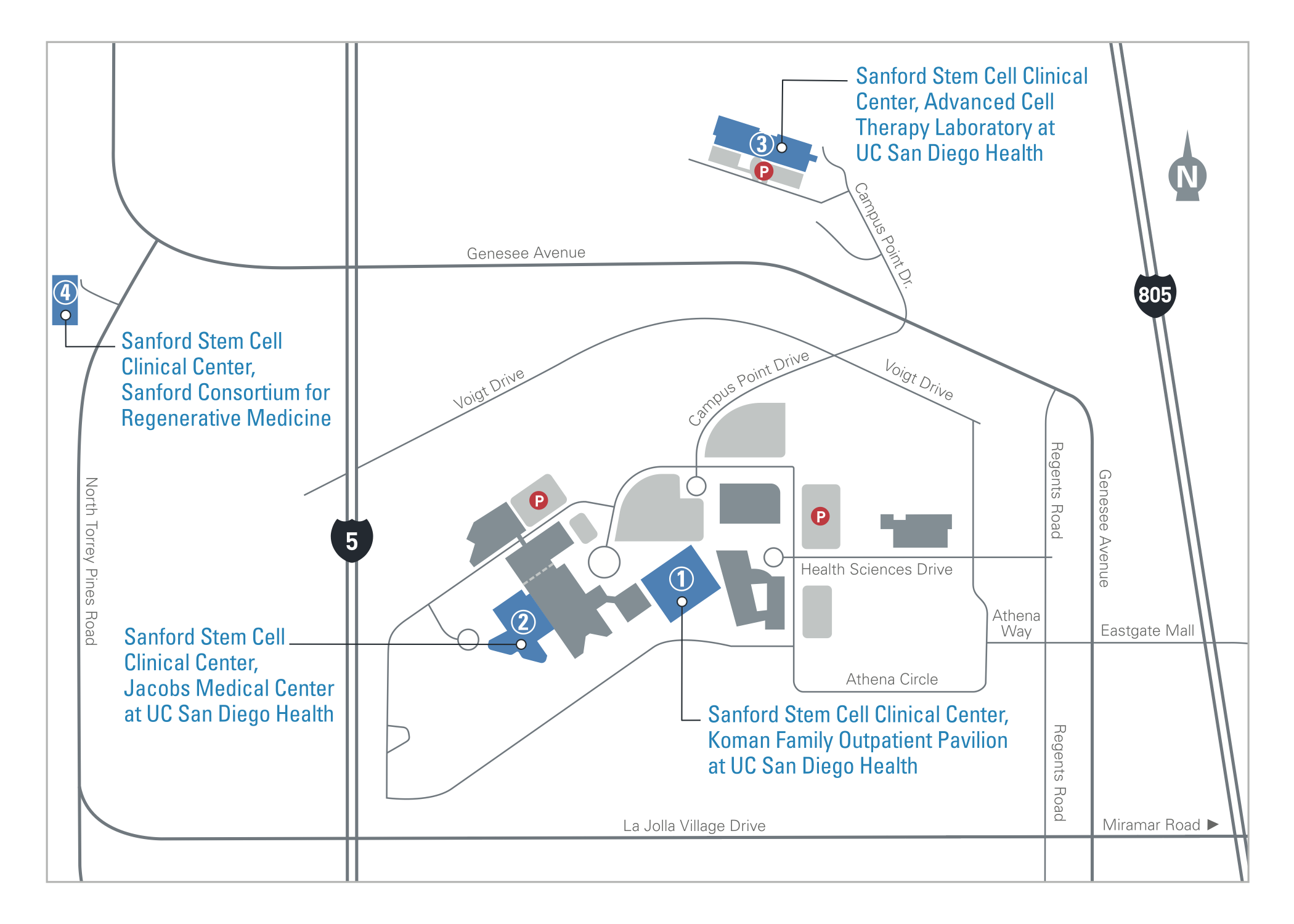
- The Sanford Stem Cell Clinical Center, which conducts research to accelerate relevant drug and therapy development in regenerative medicine. It houses the UC San Diego California Institute of Regenerative Medicine (CIRM) Alpha Clinic, which provides inpatient and outpatient cell, gene therapy, stem cell and other regenerative medicine clinical trials supported by the Division of Regenerative Medicine at the UC San Diego School of Medicine.
Our Brain Tumor and Neurorestoration Program
Additionally, SSCI is home to the Brain Tumor and Neurorestoration Program, launched in 2024. The program houses a revolutionary effort to exploit the therapeutic weaknesses of brain cancers — using stem cell-derived cancer “avatars,” CRISPR-edited to include common cancer mutations. The program partners with UC San Diego School of Medicine’s high-volume destination neurosurgical program, allowing for spatial mapping and surgical treatment of the most complex brain tumors.
SANFORD STEM CELL INSTITUTE (SSCI) is a global leader in regenerative medicine and hub for stem cell science and innovation in space. SSCI aims to catalyze critical basic research discoveries, translational advances, and clinical progress terrestrially and in space to develop and deliver novel therapeutics to patients.

WHERE WE ARE